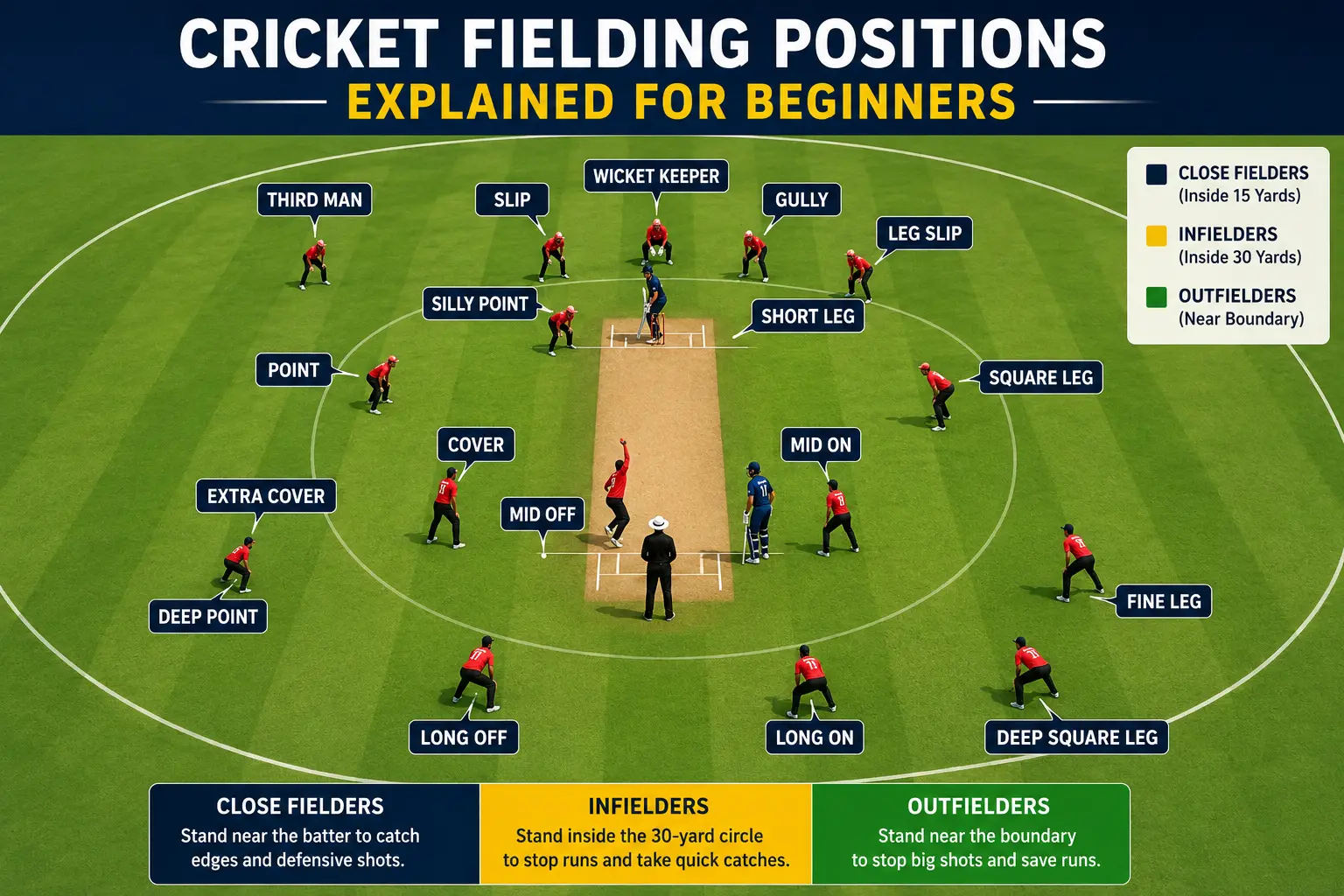
Cricket is a game of strategy, skill, and teamwork. While batting and bowling often receive the most attention, fielding plays an equally important role in determining the outcome of a match. One of the first things every cricket fan or beginner should learn is the different fielding positions used on a cricket field.
Understanding cricket fielding positions helps you follow the game more easily and appreciate the tactics used by captains and bowlers. In this guide, we explain the most common fielding positions in simple terms.
What Are Cricket Fielding Positions?
Fielding positions are the designated areas where players stand when the opposition is batting. The captain places fielders in specific positions to stop runs, create pressure, and take catches.
The location of fielders depends on factors such as:
- Type of bowler
- Batting style of the batter
- Match situation
- Pitch conditions
- Team strategy
A well-planned field setup can often make the difference between winning and losing.
Why Are Fielding Positions Important?
Fielding positions help teams achieve several objectives:
- Prevent easy runs
- Create catching opportunities
- Support bowlers
- Put pressure on batters
- Control scoring areas
Captains continuously adjust field placements based on how the game develops.
Understanding the Cricket Field
The cricket field is generally divided into three areas:
Close Fielding Area
These positions are located near the batter and are mainly used to catch edges or defensive shots.
Infield Area
These fielders stand inside the 30-yard circle and help prevent singles.
Outfield Area
Fielders positioned near the boundary focus on stopping boundaries and catching high shots.
Close Fielding Positions
Slip
Slip fielders stand beside the wicketkeeper on the off side.
Their primary role is to catch edges from batters, especially when fast bowlers are bowling.
Slip is one of the most important catching positions in cricket.
Leg Slip
Leg slip stands on the leg side behind the batter.
This position is often used when bowlers are targeting the batter’s leg side.
Gully
Gully is positioned wider than slip and slightly in front.
Fielders in this position often catch powerful edges that do not reach the slip cordon.
Silly Point
Silly point stands very close to the batter on the off side.
This position is commonly used against spin bowlers.
Short Leg
Short leg is located close to the batter on the leg side.
The fielder wears protective equipment because of the close distance.
Infield Positions
Point
Point stands square of the wicket on the off side.
This position stops cut shots and square drives.
Cover
Cover is one of the most recognizable fielding positions.
The fielder stands on the off side between point and extra cover.
Many elegant cricket shots are played through the cover region.
Extra Cover
Extra cover is positioned slightly straighter than cover.
Fielders here stop drives played by attacking batters.
Mid-Off
Mid-off stands on the off side near the bowler.
This position is frequently involved in stopping straight drives.
Mid-On
Mid-on is located opposite mid-off on the leg side.
The fielder prevents runs from straight shots played toward the leg side.
Square Leg
Square leg stands square of the wicket on the leg side.
The position is important for stopping flicks, pulls, and sweeps.
Outfield Positions
Third Man
Third man is positioned behind the batter on the off side near the boundary.
The role is to stop edges that travel past the slip fielders.
Deep Point
Deep point stands near the boundary on the off side.
This position is common in limited-overs cricket.
Deep Cover
Deep cover protects the boundary against attacking cover drives.
Long-Off
Long-off is positioned straight on the off side near the boundary.
It is frequently used when batters attempt big shots.
Long-On
Long-on stands straight on the leg side boundary.
The position helps prevent sixes and catches lofted shots.
Fine Leg
Fine leg stands behind square on the leg side.
The fielder often stops glances and deflections.
Deep Square Leg
Deep square leg is placed near the boundary on the leg side.
This position is useful against pull and hook shots.
Most Common Fielding Positions in Modern Cricket
Modern cricket frequently uses these positions:
- Slip
- Point
- Cover
- Mid-Off
- Mid-On
- Square Leg
- Fine Leg
- Third Man
- Long-On
- Long-Off
These positions provide balance between attacking and defensive strategies.
How Captains Choose Fielding Positions
Captains do not randomly place fielders around the ground.
Several factors influence field placement:
Batter’s Strengths
If a batter prefers playing on the leg side, additional fielders may be placed there.
Type of Bowler
Fast bowlers often use slips and gullies, while spinners rely on short leg and silly point.
Match Format
T20 cricket usually requires boundary protection, while Test cricket focuses more on taking wickets.
Match Situation
A team defending a low score may use aggressive fields, while a team protecting a large total may spread fielders across the boundary.
Tips for Beginners Learning Fielding Positions
If you are new to cricket, follow these tips:
- Learn the difference between off side and leg side.
- Understand where the batter is standing.
- Watch field changes during live matches.
- Observe how field placements change for spin and pace bowling.
- Study cricket field diagrams for better understanding.
With practice, identifying fielding positions becomes much easier.
Frequently Asked Questions
What is the most important fielding position in cricket?
Slip is often considered one of the most important fielding positions because many wickets come from edges caught in the slip cordon.
What is the difference between mid-on and mid-off?
Mid-on is positioned on the leg side, while mid-off is positioned on the off side.
Why is slip fielding important?
Slip fielders are responsible for catching edges from batters, particularly against fast bowling.
What is a close-in fielder?
A close-in fielder stands near the batter to catch defensive shots and create pressure.
Final Thoughts
Cricket fielding positions are a key part of the game’s strategy. Every position has a specific purpose, whether it is taking catches, preventing runs, or supporting the bowler’s plan.
For beginners, learning these positions can greatly improve their understanding of cricket. As you watch more matches, you will notice how captains constantly adjust field placements to gain an advantage.
Once you understand the basics of cricket fielding positions, following the tactical side of the game becomes much more enjoyable and rewarding.